Fundamental vs Technical Analysis: Which One Should Actually Guide Your Trades?
Fundamental vs Technical Analysis: Which One Should Actually Guide Your Trades?
Ask ten traders how they pick a stock or a currency pair, and you'll probably get two very different answers. Half will talk about earnings reports, interest rates, and company balance sheets. The other half will pull up a chart and start pointing at moving averages and support levels. Both groups are convinced they're doing it "the right way" — and honestly, both have a point.
This is the classic divide of fundamental vs technical analysis, and understanding where each one shines (and where each one falls short) can save you from years of confusion about why your trades sometimes work and sometimes don't, even when you were "sure" about the setup.
What Is Fundamental vs Technical Analysis?
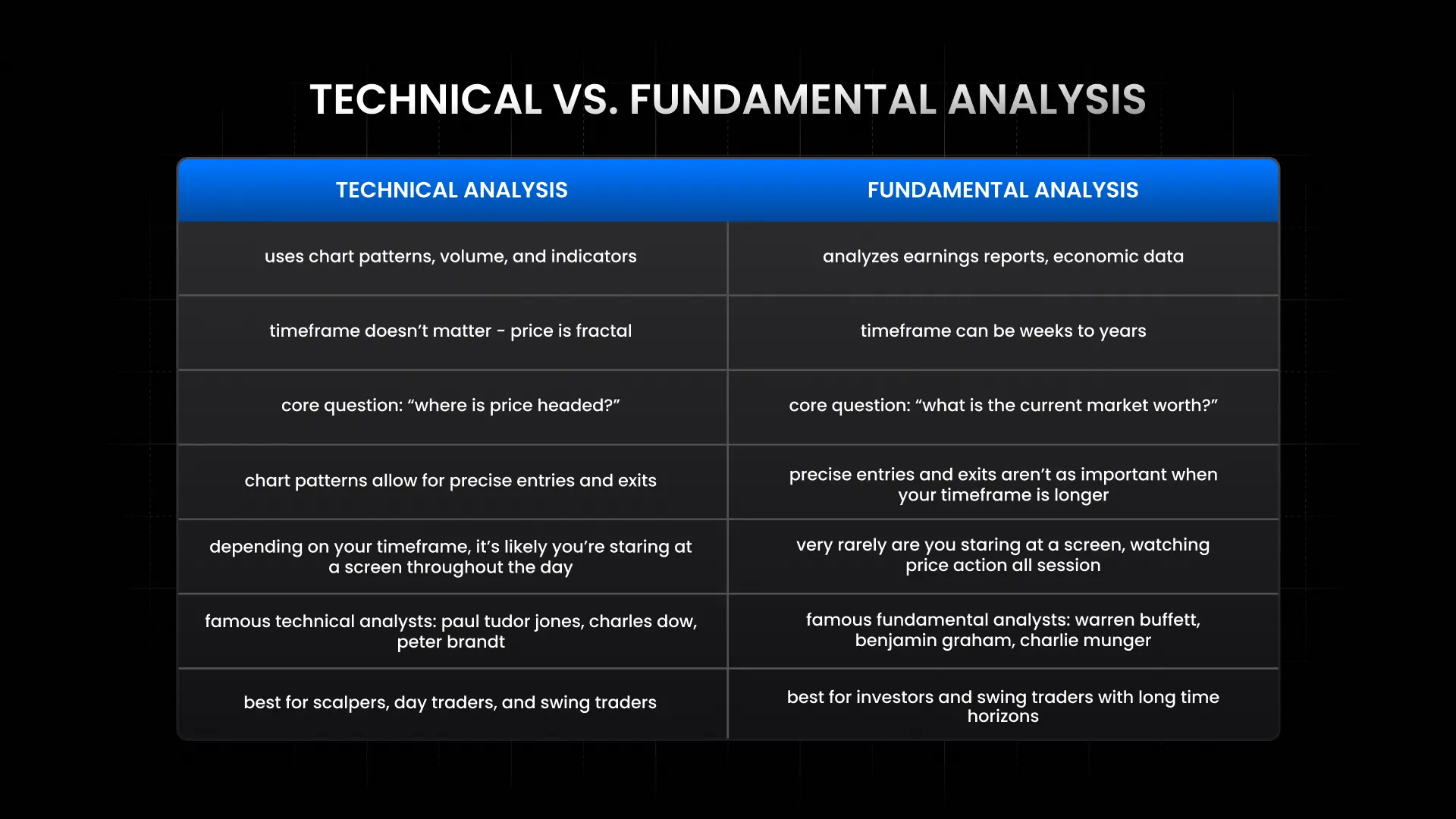
Fundamental analysis looks at the underlying value of an asset — a company's earnings, revenue growth, debt levels, or for currencies, a country's interest rates, GDP, and employment data. The core question it asks is: is this asset actually worth more or less than its current price, based on real economic substance?
Technical analysis, on the other hand, ignores most of that and studies price action itself — chart patterns, indicators, support and resistance, volume. The core question here is different: regardless of "why," where is price actually headed based on how it's been behaving?
Think of it like buying a used car. Fundamental analysis is popping the hood, checking the engine, mileage, and service history — figuring out what the car is genuinely worth. Technical analysis is watching how fast similar cars have been selling at the dealership lately and at what prices — reading the market's behavior rather than the car's internals. Good buyers sometimes do both.
Fundamental Analysis vs Technical Analysis vs Sentiment Analysis
These two often get compared directly, but there's actually a third lens worth knowing about too.
- Fundamental analysis: Focused on intrinsic value — earnings, economic data, financial health. Slower-moving, better suited to longer-term positions.
- Technical analysis: Focused on price behavior and patterns. Works across almost any timeframe, from minutes to months, and doesn't require reading financial statements.
- Sentiment analysis: Focused on crowd psychology — how bullish or bearish the overall market mood is, often measured through positioning data, news tone, or social media chatter. Neither purely fundamental nor purely technical, but frequently used alongside both.
If fundamental analysis answers "what is this actually worth," and sentiment analysis answers "how does the crowd currently feel about it," technical analysis strategy answers a narrower but very practical question: "where is price likely to go next, based on how it's been moving?"
Best Tools and Approaches for Each Method
Neither camp is short on tools. Here's what shows up most often on each side, and how solid technical analysis for fundamental vs technical comparisons typically break it down.
Fundamental Analysis Tools
For stocks, this usually means digging into earnings reports, price-to-earnings ratios, revenue growth trends, and debt-to-equity levels. For forex, it means tracking interest rate decisions, inflation data (CPI), employment reports (like NFP), and GDP growth. The underlying goal is always the same: figure out if the asset's real economic story supports its current price.
Technical Analysis Tools
Moving averages, RSI, MACD, support and resistance zones, and chart patterns like head-and-shoulders or double tops all fall under this umbrella. These tools don't care why price is moving — only that it is, and that certain patterns tend to repeat because of how buyers and sellers collectively behave.
Where They Overlap: Timing an Entry
Here's where a lot of experienced traders quietly blend both worlds. They might use fundamentals to decide what to buy (a company with strong earnings growth, or a currency backed by a hawkish central bank), then use best indicators for fundamental vs technical timing — like waiting for a pullback to a support level — to decide exactly when to actually enter.
Why Long-Term Investors Lean Fundamental
Someone holding a position for years cares much more about whether a company will still be profitable in five years than about this week's candlestick pattern. Fundamental analysis naturally fits longer horizons, since real economic value tends to reveal itself over quarters and years, not hours.
Why Short-Term Traders Lean Technical
A day trader or swing trader rarely has the luxury of waiting years for "fair value" to materialize. Price action, momentum, and chart patterns move on a timeframe that actually matches how they trade — which is exactly why fundamental vs technical for beginners guides so often steer short-term traders toward charts first.
Risk Management Tips for Both Approaches
Whichever camp you lean toward, risk management doesn't change much — the tools you use to find a trade and the tools you use to protect it are different conversations.
- Don't let strong fundamentals excuse ignoring a stop-loss. A "great company" can still have a stock that drops 20% before the market agrees with you.
- Don't let a clean chart pattern excuse ignoring the news calendar. A textbook technical setup can be blown apart in seconds by an earnings surprise or a surprise rate decision.
- Size positions based on volatility, not conviction. Being "sure" about a trade — fundamentally or technically — isn't a reason to risk more than your plan allows.
- Separate the entry signal from the exit plan. Whichever method got you into a trade, define your stop-loss and target in advance rather than deciding in the moment.
- Recognize when the two methods disagree. Strong fundamentals with a clearly bearish chart (or vice versa) is often a signal to reduce size or wait, rather than picking whichever story you like better.
Common Mistakes Beginners Make
New traders tend to pick a side too early and defend it too stubbornly — here's how that usually plays out.
- Treating it as an either/or choice. Believing you must be "a fundamental trader" or "a technical trader," when most experienced traders quietly use both to different degrees.
- Ignoring price action because the fundamentals look great. A genuinely undervalued asset can still stay undervalued (or fall further) for a long time — the market doesn't have to agree with your analysis on your timeline.
- Ignoring fundamentals because the chart looks perfect. A beautiful technical setup right before a major earnings release or economic report is a much riskier trade than the same setup on a quiet day.
- Overcomplicating fundamental analysis early on. Trying to master every financial ratio before making a single trade, instead of starting with a few core metrics and building from there.
- Overloading charts with indicators. Stacking ten technical indicators on one chart usually creates more confusion than clarity — most professional technical traders use just a handful.
- Confusing being right with being profitable. Correctly predicting a company's long-term value doesn't help if poor timing or poor risk management wipes out the position before that value is realized.
Conclusion
The debate over fundamental vs technical analysis doesn't really have a single winner — it depends heavily on your trading timeframe, your personality, and what kind of information you find easiest to act on with confidence. Long-term investors generally lean on fundamentals to decide what's worth owning; short-term traders generally lean on technicals to decide when to act. Many of the most consistent traders eventually stop picking a side entirely and instead use fundamentals to shape their bigger-picture view, while letting charts guide the precise timing of entries and exits.
You don't have to choose a religion here. You just have to understand what each tool is actually telling you — and use the right one for the decision in front of you.
Frequently Asked Questions
1. Which is better for beginners — fundamental or technical analysis?
Many beginners find technical analysis easier to start with, since chart patterns and indicators are visual and don't require deep knowledge of financial statements or macroeconomics. That said, a basic understanding of fundamentals helps avoid being blindsided by news events.
2. Can fundamental and technical analysis be used together?
Yes, and many experienced traders do exactly that — using fundamentals to identify what to trade and technicals to time the entry and exit. This combined approach is often called a "top-down" strategy.
3. Is technical analysis useless for long-term investing?
Not useless, but generally less central. Long-term investors typically weight fundamentals more heavily, though some still use technicals to time entries during pullbacks or avoid buying at short-term price extremes.
4. Why do fundamentally strong stocks sometimes keep falling in price?
Markets can stay disconnected from "fair value" for extended periods due to sentiment, broader market conditions, or sector-wide selling — which is exactly why technical analysis and risk management matter even when the fundamental case looks strong.