High-Impact News Guide: What NFP, FOMC & CPI Mean for Your Trades
High-Impact News Guide: What NFP, FOMC, and CPI Actually Mean for Your Trades
If you've spent any time around forex or stock trading forums, you've definitely seen these three acronyms thrown around like everyone already knows exactly what they mean: NFP, FOMC, CPI. For a beginner, it can feel a bit like walking into a conversation already in progress. So let's slow down and actually break down this high impact news trio — what each one is, why the market reacts so violently to them, and how to actually prepare instead of just reacting in real time.
These three releases are consistently among the most volatile, most-watched events on the entire economic calendar. Understanding them isn't optional if you're trading forex, indices, or anything tied to the broader economy — it's foundational.
Why These Three Events Matter So Much
Markets are essentially giant pricing machines constantly trying to figure out the future value of currencies, stocks, and bonds based on expectations. NFP, FOMC, and CPI are three of the clearest windows into the health of the economy and the direction of monetary policy — which is exactly why price reacts so sharply when the actual numbers differ from what everyone expected.
Think of it like a report card for the entire economy. Most of the time, analysts have a rough guess at the grade before it's released. When the actual grade matches the guess, not much happens. But when it comes in wildly different — better or worse than expected — that surprise is what triggers the sharp moves you see on the chart.
NFP (Non-Farm Payrolls)
NFP measures the change in the number of employed people in the U.S., excluding farm workers, government employees, and a few other categories. It's released monthly, typically on the first Friday of the month, and it's one of the most closely watched economic indicators for traders anywhere in the world.
Why It Moves Markets
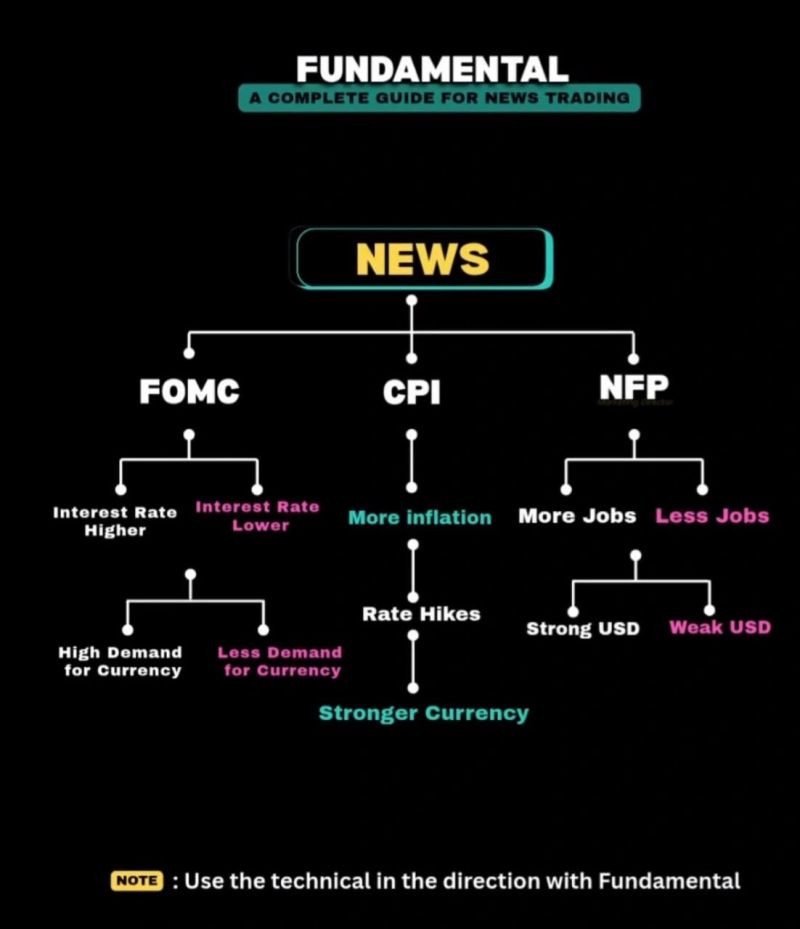
Employment data is a direct signal of economic strength. A much stronger-than-expected number often suggests a healthy, growing economy, which can influence expectations around interest rates. A much weaker number can spark concerns about slowing growth. Because this single number reflects millions of jobs across the entire country, surprises tend to trigger sharp, fast moves in currency pairs, especially those involving the U.S. dollar.
What to Watch Beyond the Headline Number
Experienced traders don't just look at the main figure — they also check wage growth and unemployment rate figures released alongside it, since these can sometimes tell a more complete story than the headline number alone.
FOMC (Federal Open Market Committee)
FOMC refers to the committee responsible for setting U.S. monetary policy, most notably interest rate decisions. Their meetings happen roughly eight times a year, and the announcements that follow are consistently among the most volatile events on the calendar.
Why It Moves Markets
Interest rates influence virtually everything — borrowing costs, currency strength, stock valuations, and bond yields. When the committee raises, lowers, or holds rates differently than expected, or signals a shift in future policy through their statement, markets can move sharply within seconds. It's not just the rate decision itself that matters — the tone and wording of the accompanying statement, along with the press conference that follows, often move markets just as much as the number itself.
What to Watch Beyond the Rate Decision
Pay close attention to forward guidance — hints about future policy direction — since markets often react more to expectations about what's coming next than to the current decision alone.
CPI (Consumer Price Index)
CPI measures the average change in prices for a basket of goods and services over time, making it the primary gauge of inflation. It's released monthly and directly influences expectations around central bank policy, which is exactly why it ranks among the most-watched high impact news events every month.
Why It Moves Markets
Inflation data heavily influences interest rate decisions. Higher-than-expected inflation often raises expectations of tighter monetary policy, while lower-than-expected readings can suggest the opposite. Because interest rate expectations ripple through currencies, stocks, and bonds alike, CPI surprises frequently produce some of the sharpest single-event moves of the entire month.
What to Watch Beyond the Headline Figure
Core CPI, which strips out volatile food and energy prices, is often considered a cleaner read on underlying inflation trends and is watched just as closely as the headline number by many traders.
How to Prepare for These Specific Releases
- Know the exact release time and date in advance. These are scheduled well ahead of time on any economic calendar, so there's no excuse for being caught off guard.
- Check the consensus forecast beforehand. Market reaction is driven by the gap between actual and expected figures, not the number in isolation.
- Reduce position size or step aside if you're unfamiliar with the pattern. These three releases are not the place to learn news trading with a full-sized position.
- Watch the reaction, not just the headline. Sometimes the initial spike reverses within minutes as the market fully digests the details behind the number.
Preparing for these events is a bit like knowing a big storm is forecast for a specific afternoon. You wouldn't be caught off guard by weather you knew was coming — the same logic applies here, since the release times are public information well in advance.
Common Mistakes Traders Make With These Events
- Confusing the headline number with the full picture. Wage growth alongside NFP, or core figures alongside CPI, often matter just as much as the main number.
- Ignoring the forecast entirely. A "strong" number that still misses expectations can still cause a negative reaction, and vice versa.
- Trading FOMC on the rate decision alone. The statement and press conference frequently move price more than the decision itself.
- Using full position size on unfamiliar events. These three releases regularly produce some of the sharpest volatility of the month.
- Assuming the first move is the final move. Initial spikes on all three of these events commonly reverse once the broader context is absorbed.
Conclusion
NFP, FOMC, and CPI aren't just acronyms to memorize — they're recurring, predictable sources of major market volatility that show up on the calendar every single month. You don't need to trade every one of them, but understanding what they measure and why the market reacts the way it does puts you miles ahead of traders who get blindsided by moves they never saw coming. Mark these dates, check the forecasts, and prepare instead of react.
Knowing the calendar is half the edge. The other half is respecting exactly how much these releases can move price.
Frequently Asked Questions
1. Which is more volatile — NFP, FOMC, or CPI?
All three regularly produce significant volatility, though FOMC decisions can sometimes generate the sharpest moves due to their direct impact on interest rate expectations across multiple markets at once.
2. How often are these events released?
NFP and CPI are released monthly, while FOMC meetings and rate decisions happen roughly eight times per year, according to the pre-announced schedule.
3. Do these events only affect the U.S. dollar?
No. Because the U.S. dollar is involved in the majority of global currency pairs and the U.S. economy influences global markets broadly, these releases often affect stocks, commodities, and other currencies well beyond the dollar alone.
4. Should beginners trade these high-impact events directly?
It's generally safer for beginners to observe a few releases first, understanding typical reaction patterns, before risking real capital directly around these specific announcements.