Scalping Trading Guide: Fast-Paced Strategies for Beginners (2026)
Scalping: The Fast-Paced Trading Style for Traders Who Love Quick Decisions
Some traders love the slow burn of watching a position build over weeks. Others get bored the moment they open a chart if nothing's happening in the next two minutes. If you fall into that second camp — if you'd rather make twenty quick decisions in an hour than one big decision in a month — scalping might be exactly the style you've been looking for.
This is trading stripped down to its fastest, most reactive form. No waiting days for a trend to play out, no holding overnight and hoping nothing blows up while you sleep. Just rapid entries, rapid exits, and small profits stacked one on top of another. It's not for everyone — but for the right personality, it's one of the most engaging ways to trade. Let's break down exactly how it works.
What Is Scalping Trading?
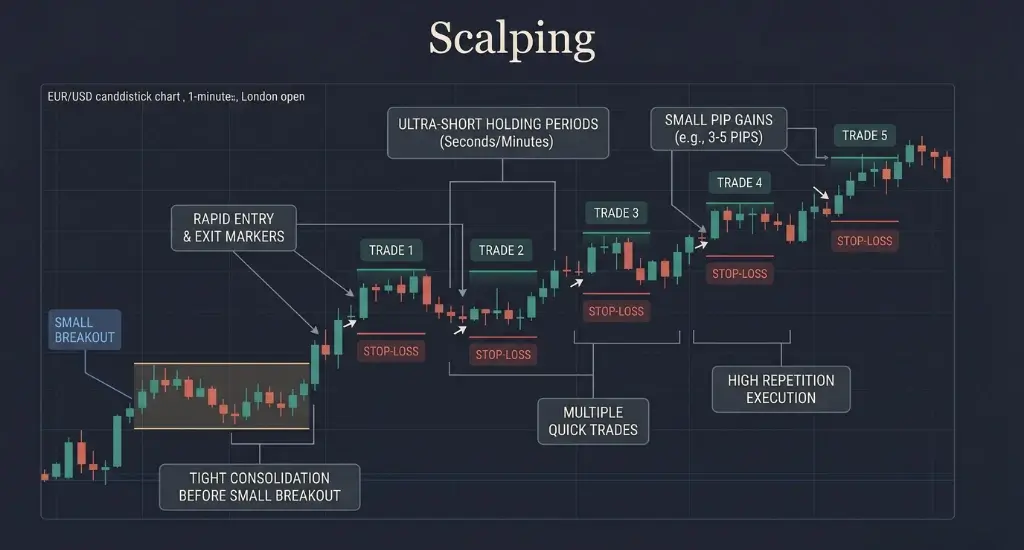
At its simplest, scalping means opening and closing trades within minutes — sometimes even seconds — aiming to capture tiny price movements dozens or even hundreds of times a day. A single scalp might only target a few cents or a handful of pips, but multiply that across many trades in a session and it can add up to a meaningful daily profit.
Think of it like a shopkeeper who makes a small margin on every item sold but moves enormous volume — the profit isn't in any single sale, it's in the sheer number of transactions. A scalper isn't trying to catch the "big move" of the day; they're trying to catch dozens of small, repeatable ones, in and out before the market even has time to change its mind.
Because positions are held for such short windows, scalping demands intense focus, fast execution, and a broker with tight spreads and low latency. It's less about predicting where the market goes over the next hour and more about reading the very next few ticks.
Scalping vs Day Trading vs Long-Term Investing
People often assume scalping and day trading are the same thing, but they sit at very different speeds on the same spectrum.
- Scalping: Trades last seconds to a few minutes. Dozens or hundreds of trades per session, tiny profit targets, and constant screen attention with zero room for distraction.
- Day trading: Trades last minutes to hours, all closed by end of day. Fewer trades than scalping, larger profit targets per trade, and slightly more breathing room between decisions.
- Long-term investing: Positions held for years, based on fundamentals rather than tick-by-tick price action, with almost no need for constant monitoring.
If long-term investing is a slow-cooked meal and day trading is a quick stir-fry, scalping strategy is more like fast food at a drive-through — rapid, repetitive, and built entirely around speed and volume rather than lingering over any single order.
Best Indicators and Strategies for Scalping
Scalping lives and dies on speed, so the indicators that work best are the ones that react instantly rather than smoothing things out over long periods. Here's what shows up in serious technical analysis for scalping.
1-Minute and 5-Minute Charts
Scalpers operate almost entirely on the shortest timeframes available. A 1-minute or 5-minute chart shows the granular price action needed to spot micro-moves that would completely disappear on a daily chart. This is the scalper's entire world — everything happens here.
Moving Average Ribbons
Instead of a single moving average, many scalpers stack several short-period moving averages (like 5, 8, and 13-period) together. When they align and fan out in one direction, it often signals a short burst of momentum worth riding for a minute or two before it fades.
Stochastic Oscillator
This is a favorite among scalpers because it reacts quickly to short-term overbought and oversold conditions — exactly the kind of rapid swings a scalper wants to exploit. A quick cross from oversold territory can flag a fast entry opportunity before the broader trend even reveals itself.
Bollinger Bands
When price pushes to the outer edge of a tight Bollinger Band and then snaps back toward the middle, it can signal a quick reversal — precisely the kind of short, sharp move scalpers are hunting for. The narrower the bands, the more explosive the eventual move tends to be.
Level 2 Order Book / Volume Spikes
Among the best indicators for scalping trading, watching the order book directly is arguably the most direct tool available. Sudden spikes in buy or sell volume often precede the tiny price bursts scalpers are trying to catch, giving an edge that lagging indicators simply can't match at this speed.
Because everything happens so fast, most scalpers combine just two or three of these tools rather than overloading their screen — clarity and reaction time matter more than complexity.
Risk Management Tips for Scalping
Here's the part that separates scalpers who last from those who blow up their account in a week: with so many trades happening so quickly, even small mistakes compound fast.
- Use extremely tight stop-losses. Since profit targets are small, losses need to be even smaller — a bad trade shouldn't cost more than two or three good ones combined.
- Watch transaction costs closely. Spreads and commissions eat into small profits fast, so scalping only makes sense with a broker offering genuinely tight spreads.
- Set a daily loss limit. Given how many trades happen in a session, it's easy to spiral after a few losses. A hard stop for the day protects both capital and mental clarity.
- Avoid trading during major news releases. Sudden volatility spikes can blow through tight stops in an instant, turning a small planned loss into a large unplanned one.
- Keep position sizes modest. High trade frequency means risk adds up quickly — smaller size per trade keeps the overall exposure manageable.
Common Mistakes Beginners Make
Scalping looks deceptively simple from the outside — fast in, fast out, repeat. In reality, a few recurring mistakes wreck most beginner scalpers.
- Ignoring spreads and fees. A strategy that looks profitable on paper can quietly lose money once realistic transaction costs are factored in.
- Overtrading out of boredom. Forcing trades during quiet, low-volatility periods just to stay active, rather than waiting for genuine setups.
- Hesitating on exits. A two-second delay that feels harmless in day trading can wipe out an entire scalp's profit margin.
- Trading without a fast, reliable platform. Slippage and execution lag hurt every trader, but they're especially brutal for a strategy built on tiny margins.
- Chasing losses immediately. Jumping straight into another trade to "win back" a loss, rather than stepping back and resetting focus.
- Underestimating the mental fatigue. Making dozens of fast decisions an hour is exhausting, and tired decision-making leads directly to sloppy trades.
Conclusion
Scalping for beginners can feel like drinking from a fire hose at first — fast charts, fast decisions, fast everything. But for traders who genuinely enjoy quick thinking and don't mind the intensity, it offers a way to generate consistent small wins without ever holding overnight risk. Start on a demo account, master one or two indicators rather than cluttering your screen, respect your stop-losses without hesitation, and track your costs as closely as your profits.
The market moves fast either way. Scalping is simply choosing to move with it, one quick trade at a time.
Frequently Asked Questions
1. How much capital do I need to start scalping?
There's no strict minimum, but since profits per trade are small, having enough capital to absorb transaction costs and occasional losses comfortably makes a big difference in staying consistent.
2. Is scalping suitable for beginners?
It can be, but it demands fast reflexes, strong discipline, and a good understanding of costs and execution. Many traders find it easier to start with swing trading or day trading before moving into the faster pace of scalping.
3. What markets work best for scalping?
Highly liquid markets with tight spreads work best — major forex pairs, large-cap stocks, and popular index futures are common choices, since liquidity keeps execution fast and costs low.
4. Can scalping be automated?
Yes, and many scalpers do use automated systems, since human reaction time is often too slow to consistently capture the tiny windows scalping relies on. Rules-based execution removes hesitation from the process entirely.